
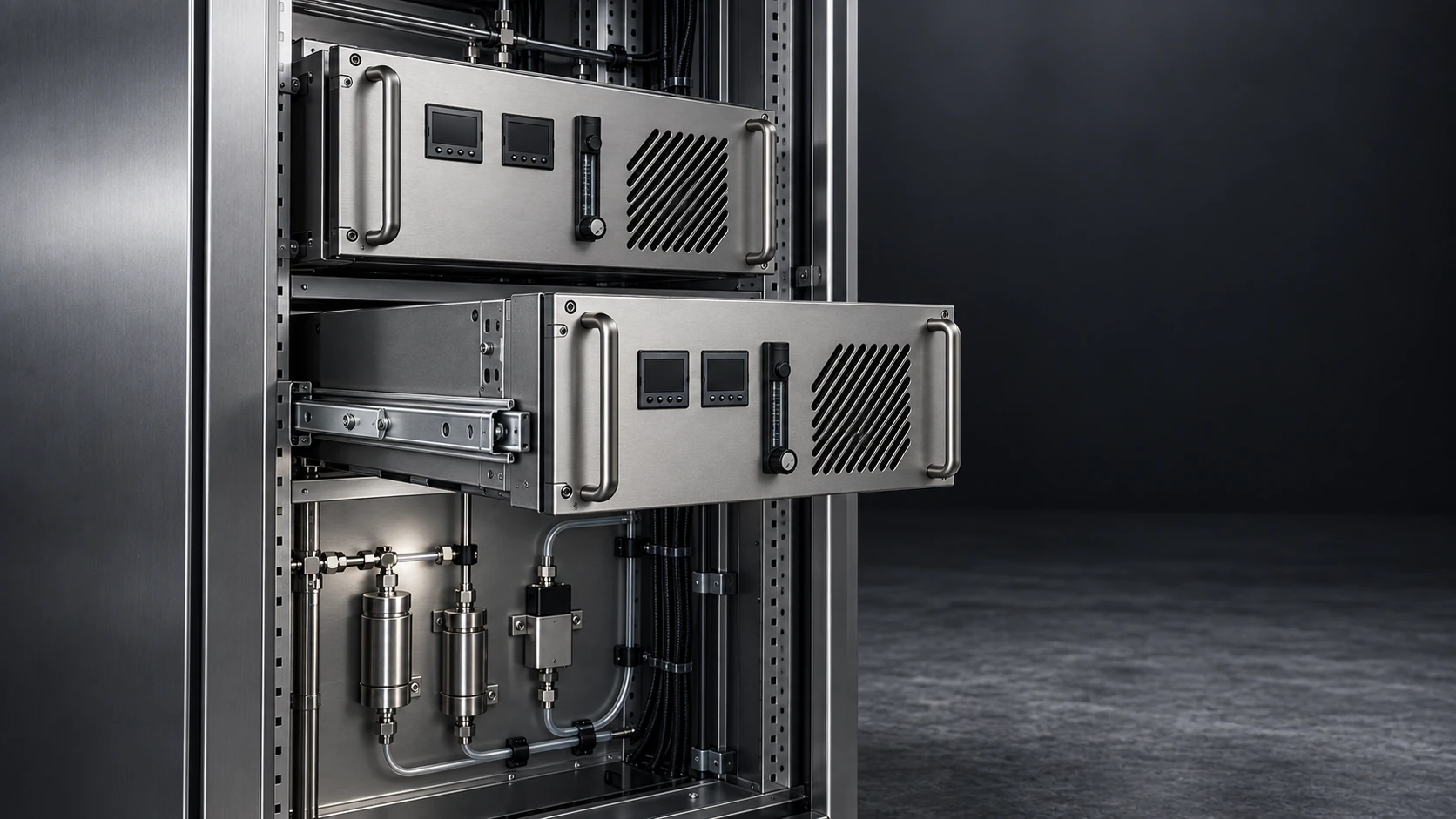
What is gas analysis?
Industrial gas analysis determines the concentration of one or more gas components in a gas stream. Measurement can be continuous, with a permanently installed analyser measuring around the clock, or periodic, with portable equipment on single occasions.
The term is sometimes confused with gas detection. Gas detection is about personal safety: a gas detector raises an alarm when a flammable or toxic gas reaches a set level in the air. Gas analysis measures the composition of the process or flue gas itself and delivers a value used for control, quality or reporting.
Emissions monitoring
Continuous measurement of emissions in flue gas, often called flue gas analysis or CEMSContinuous emissions monitoring systems: permanently installed measuring systems that measure emissions in the flue gas continuously and deliver data for reporting. EN 14181 calls them AMS, automated measuring systems.. The values are reported to the supervisory authority and used, among other things, for The NOx chargeAn environmental charge on nitrogen oxide emissions from energy production under Swedish act (1990:613). The charge is normally based on measured emissions, and the Swedish EPA’s regulation NFS 2016:13 sets requirements for the measuring equipment and its checks..
Process gas analysis
Measurement in the process to control combustion, chemical reactions and cleaning stages, or to monitor quality and safety. Common in mining, metals, pulp and paper and the chemical industry.
Combustion control
Oxygen and carbon monoxide in the flue gas show how well combustion is working. The measurement is used to adjust excess air in boilers and furnaces.
Which gases are measured?
Which components are measured depends on the process, the fuel and the permit. The table shows some common examples and where they are usually measured.
| COMPONENT | NAME | TYPICAL APPLICATION |
|---|---|---|
| NOₓ (NO, NO₂) | Nitrogen oxides: nitric oxide and nitrogen dioxide | Emissions monitoring at combustion plants, basis for the NOx charge |
| SO₂ | Sulphur dioxide | Emissions monitoring when burning sulphur-bearing fuels and in process industry |
| CO | Carbon monoxide | Combustion control and emissions monitoring |
| CO₂ | Carbon dioxide | Combustion, processes and carbon dioxide reporting |
| O₂ | Oxygen | Combustion control and correction of concentrations to Reference oxygenThe oxygen level emission values are corrected to, so that values from different plants and operating conditions are comparable regardless of excess air. The applicable level is set in the ordinance or the permit. |
| HCl, HF | Hydrogen chloride and hydrogen fluoride | Waste incineration and processes involving chlorine or fluorine compounds |
| NH₃ | Ammonia | Ammonia slip after SNCR and SCRMethods for reducing nitrogen oxides in the flue gas by adding ammonia or urea, without a catalyst (SNCR, selective non-catalytic reduction) or with one (SCR). Ammonia that does not react follows the flue gas and is called ammonia slip. flue gas cleaning |
| TOC | Total organic carbon | The sum of organic compounds, for example at waste incineration plants |
| H₂O | Water vapour | Moisture, for conversion between Dry gasGas with the water vapour subtracted. Most extractive analysers measure dry gas after the cooler, and emission values are normally reported on dry gas. An analyser that measures wet gas, such as FTIR or in-situ, therefore also needs the moisture content. and wet gas |
| CH₄, H₂S | Methane and hydrogen sulphide | Biogas, process gases and gas cleaning |
How does a gas analyser measure?
Each measuring principle uses a physical or chemical property of the gas. The choice depends on the components to be measured, the measuring range, which other gases InterferenceDisturbance from another gas that absorbs or reacts in the same way as the component of interest, for example water vapour in infrared measurement. The analyser compensates for known interferences, but only within the limits it was built for. and the conditions at the measurement point. Pick a gas to see which principles are used for it, and open a principle to see how it works.
No gas selected: all principles are shown.
Extractive or in-situ measurement?
There are two basic ways to build a gas analysis system. Both are common, and many plants have a mix.
Extractive system
A probe extracts sample gas from the duct. The gas travels through a heated sample line to the sample conditioning, which filters and often cools and dries it, before it reaches the analyser in a cabinet or analyser room. In a hot-wet system the gas is instead kept heated all the way to the analyser. Water-soluble components such as HCl, HF and NH₃ are normally measured that way, because part of them is otherwise lost in the cooler’s condensate.
- The analyser is protected and easy to reach
- Several components can be measured in the same cabinet
- More stages where the sample gas can be affected: probe, line, cooler, pump and filter
In-situ measurement
The analyser measures directly in the duct, either across it or in a probe with a measuring cell. No gas is extracted from the process.
- Short response time and no sample conditioning
- Measures in wet gas at process temperature, so the moisture content is needed for reporting on dry gas
- Optics, purge air, alignment and the process’s dust and vibration affect the measurement
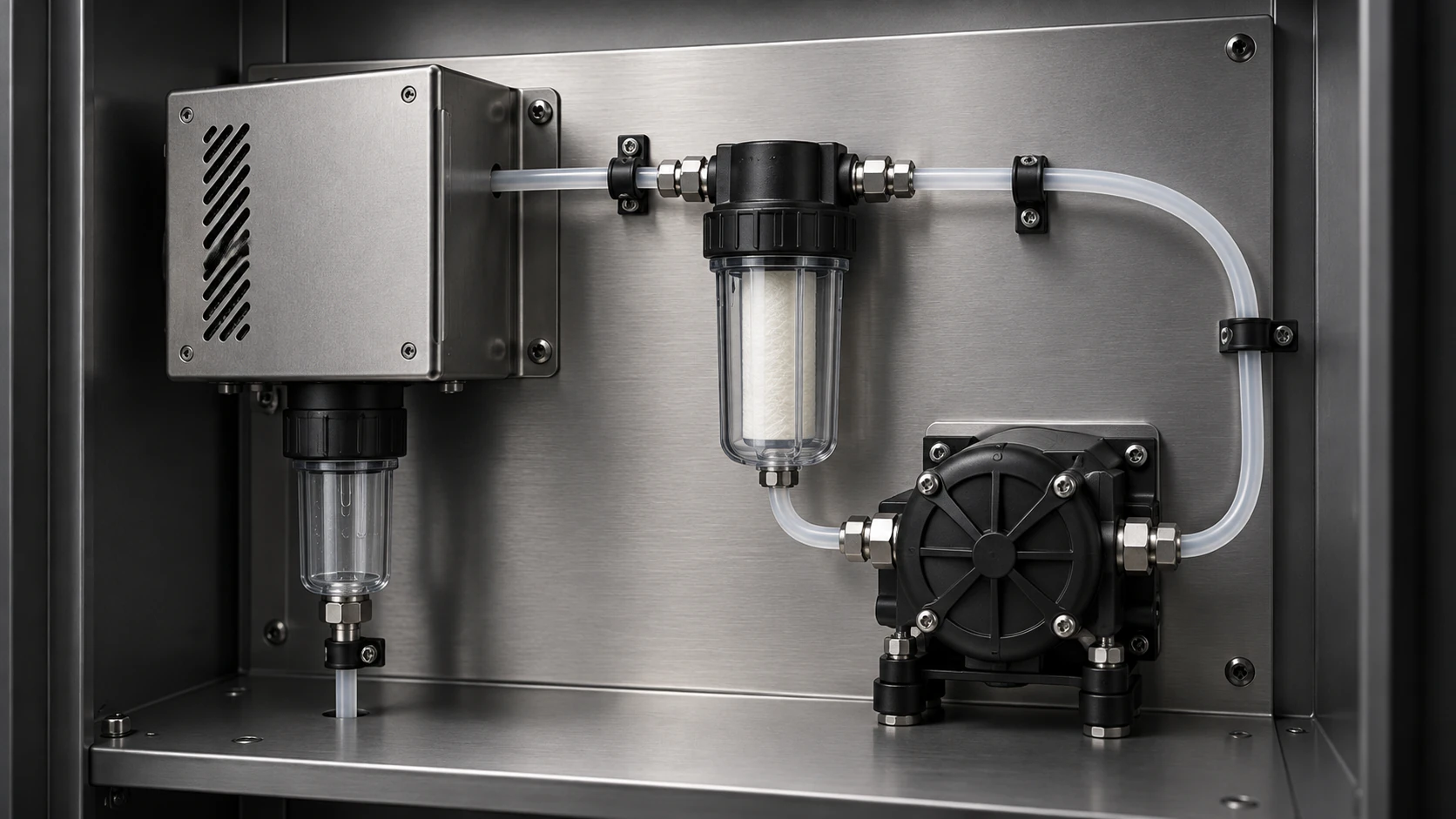
The analyser is only one stage in the chain.
The reported value passes through several stages before it ends up in a report: from the measurement point in the process via sample extraction, sample line and sample conditioning to the analyser, the signal and the data system. Every stage can affect the result.
When a reading deviates, many investigations start at the analyser. The cause is often earlier in the chain.
HOW THE MEASURING CHAIN IS BUILT →Common causes of deviating readings
These are faults we often find when troubleshooting gas analysis systems. Several of them first appear as a slow change in the reading.
Air ingress
Leaks in the probe, gaskets or fittings let in ambient air, so-called Air ingressAmbient air leaking into the measuring system, for example through a cracked gasket or a loose fitting, diluting the sample gas before it reaches the analyser.. The sample gas is diluted: concentrations fall and oxygen rises.
Condensation and cold spots
A break in the heating of the sample line makes water condense. Water-soluble gases such as SO₂, NO₂, HCl, HF and NH₃ are lost with the condensate and read too low.
Blocked filters
Dust in the probe filter and fine filters reduces the flow and lengthens Response timeThe time from a change in concentration at the measurement point until the analyser shows it. It depends on the sample gas flow, the length of the line and the volumes in filters, cooler and analyser.. The vacuum after the filter increases, which can draw in air through small leaks.
Sample conditioning
A cooler that does not hold its temperature, a condensate drain that does not empty or a worn pump affects both the flow and the composition of the sample gas.
Analyser drift
Zero and SpanThe analyser’s reading at a known high concentration, as opposed to the zero point. A span check shows whether the sensitivity has changed since the last check. change over time. Regular checks with Zero gasA gas that does not contain the component being measured, usually nitrogen or purified air. Used to check and set the analyser’s zero point. and Calibration gasA gas of known concentration covering the analyser’s measuring range, normally in the upper part of the measuring range. Used to check and adjust the span value, the reading at a high, known concentration. pick this up.
Signal and scaling
A wrong measuring range, wrong scaling or a signal fault between the analyser and the control system gives a value that is correct in the analyser but not in the report.
Drag the slider to see what an air leak in the measuring system does to the readings. The example starts from a flue gas with 80 ppm NO and 6.0 % O₂ diluted with ambient air.
The oxygen correction almost fully compensates for the dilution, so the reported value can look normal. The leak shows instead in the raw value and in an oxygen level that rises without any change in combustion.
ILLUSTRATIVE EXAMPLE · SIMPLIFIED MODEL · NOT REAL PLANT DATARequirements for emissions monitoring in Sweden
Plants that monitor emissions continuously must show that the measuring system is suitable, calibrated and checked. Which requirements apply depends on the plant’s permit and the ordinances it falls under.
EN 14181
The standard for quality assurance of automated measuring systems. QAL1 is the type testing and certification under EN 15267-3 that shows the system is suitable, QAL2 calibrates the installed system through parallel measurements by an Accredited laboratoryA measurement laboratory whose competence for the relevant methods has been assessed and approved by a national accreditation body, Swedac in Sweden. Comparative measurements such as QAL2 and AST must be carried out by an accredited laboratory., QAL3 is OperatorThe party running the plant. The operator is responsible for complying with the permit conditions, for self-monitoring and for checking and documenting the measuring system.’s ongoing zero and span check, and AST is the annual surveillance test between QAL2 calibrations, also by an accredited laboratory.
Large combustion plants and waste incineration
Ordinances (2013:252) and (2013:253) require quality assurance to CEN standardsEuropean standards (EN) developed by CEN, the European Committee for Standardization. In Sweden they are adopted as Swedish standards with the designation SS-EN, for example SS-EN 14181. and an annual check by parallel measurements.
The NOx charge
Under NFS 2016:13 the measuring equipment must be checked at least once per calendar month. If the deviation at the zero or reference point exceeds 4.0 % of the reference-point concentration, for NOₓ at least 2.0 ppm, the equipment must be adjusted, and the values since the last approved check do not count as valid. A comparative measurement by an accredited laboratory is also required at least once per calendar year, or every third chargeable year for units with under 2,000 operating hours per year.
Responsibility for the checks lies with the operator. Accredited measurements such as QAL2 and AST are carried out by accredited laboratories.
READ MORE ABOUT QAL3 IN PRACTICE →Service for gas analysis, regardless of manufacturer.
ARKTEC troubleshoots, repairs and maintains gas analysers and emissions monitoring systems, from probe and sample line to sample conditioning, analyser and signal. We are based in Stockholm and take assignments across Sweden, on demand or by agreement.
Questions about gas analysis
What is the difference between gas analysis and gas detection?
Gas detection protects people: a gas detector raises an alarm when a hazardous gas reaches a set level in the air. Gas analysis measures the composition of a process or flue gas and gives a value for control, quality or reporting.
What is a gas analyser?
An instrument that measures the concentration of one or more gas components, such as NOₓ, SO₂, CO or O₂. It is usually part of a measuring system with sampling, sample conditioning and data transfer.
What is CEMS?
CEMS stands for continuous emissions monitoring systems. They are permanently installed systems that measure emissions in flue gas continuously and deliver data for reporting.
How often does a gas analysis system need to be checked?
It depends on the requirements and the system. Measuring equipment used for the Swedish NOx charge must be checked at least once per calendar month under NFS 2016:13. Plants covered by EN 14181 also run QAL3 checks continuously and an annual surveillance test (AST) by an accredited laboratory. Beyond the requirements, the interval depends on how quickly filters, coolers and other parts are affected by the process.
What do ppm, mg/Nm³ and reference oxygen mean?
The analyser often shows concentration in ppmParts per million by volume. 1 ppm corresponds to 1 cm³ of the gas per m³ of gas mixture. Analysers often show concentration in ppm or in volume per cent., parts per million by volume. Emission values are instead reported in mg/Nm³Milligrams per normal cubic metre: the mass of the gas per cubic metre, corrected to 0 °C and 101.3 kPa, normally on dry gas. It is the unit emission values are usually reported in., milligrams per normal cubic metre at 0 °C and 101.3 kPa, on Dry gasGas with the water vapour subtracted. Most extractive analysers measure dry gas after the cooler, and emission values are normally reported on dry gas. An analyser that measures wet gas, such as FTIR or in-situ, therefore also needs the moisture content. and corrected to a Reference oxygenThe oxygen level emission values are corrected to, so that values from different plants and operating conditions are comparable regardless of excess air. The applicable level is set in the ordinance or the permit.: 6 % for solid fuels, 3 % for liquid and gaseous fuels, 15 % for gas turbines and gas engines and 11 % for waste incineration. That is why oxygen, and often moisture, are measured as well.
Does ARKTEC service all manufacturers?
We work regardless of manufacturer and have experience with analysers, sampling and sample conditioning from several manufacturers. Tell us the manufacturer and model you have, and we will say what we can do and when the manufacturer’s own service is needed.
Does ARKTEC carry out QAL2 or AST?
No. QAL2 and AST are carried out by accredited laboratories. We carry out technical checks, adjustment and calibration with calibration gas, and provide documentation to support your QAL3 work.
What does service of a gas analysis system cost?
Single assignments are priced by quote. With a service agreement, the price is a fixed annual price per site or by quote. An agreement is not a requirement.